
The ship wherein Theseus and the youth of Athens returned from Crete had thirty oars, and was preserved by the Athenians down even to the time of Demetrius Phalereus, for they took away the old planks as they decayed, putting in new and stronger timber in their places…
https://en.wikipedia.org/wiki/Ship_of_Theseus
— Plutarch, Theseus[9]
The problem with the present
Not just the mighty Ship of Thesus, even the mightiest of organisations need to change their planks from time to time in order to stay relevant and competitive in this rapidly changing world.
Organisations quite often need to change their planks and put in new and stronger ones, not at the comforts of a shore like Thesus’ ship, but while sailing on high seas.
I’m NOT trying to convince why enterprise transformation is necessary. The case is well established. But for many, it is a “programme”, often known with different names – digital transformation programme, finance transformation programme, restructuring programme, reengineering programme, downsizing programme and so on. For others, it is also a programme with start and end dates, that can be outsourced to the lowest bidder of the RFP.
This isn’t new. If you are in the C-Suite or C-1 / C-2 (target group of this article), you must have come across this predicament before. Corporate history is littered with many examples. As this is not new, there are plenty of strategic management models to analyse current position and frame a desired state. There are also new age canvases like Business Model Canvas, Lean Canvas, Product Canvas etc. to define strategic position as well as deliver the outcomes associated with it. Delivery Frameworks / Methodologies (PMI, Prince2, Agile etc.) and tools (ERP, CRM tools, Portfolio delivery tools like Clarizen One, Planview, Primavera, Atlassian Jira etc.) are everywhere, promising “transformation nirvana”. Then there are infrastructure & integration service providers (HP, DELL, AWS, GCP, MS Azure, …) flashing the same along with plenty of Systems Integrators.
Though useful, the approach in all these is not “holistic”. Quite often, Strategy, Innovation, Organisational Design, Organisational Change & Delivery activities are treated as discrete and are addressed independently. Such thinking led to the proliferation of boutique innovation firms, pure-play strategy consulting firms, OD / OC experts dealing with predominantly people & communications side of change management etc. It is not the problem of these consultancies, their approaches or their business models, rather how these efforts come together contributing to your organisation’s transformation for the long-term is the problem I’m trying to address here.
It is that how part of that transformation.
My views on Enterprise Transformation
“Enterprise transformation” is not a transactional activity with a timeframe & budget; nor it is about “shuffling boxes or moving boxes around” in the organisational hierarchy. Also, it is not about strategy development or implementation of new CRM. Enterprise Transformation is not some mythical future state or a destination and once you achieve that state, you hope the sail would be smooth from then onwards, metaphorically speaking.
In the words of Lou Gerstner, the former CEO of IBM “Transformation means that you’re really fundamentally changing the way the organisation thinks, the way it responds, and the way it leads”. For me
Enterprise transformation is the way an organisation evolves in relation to its environment, both internal and external.
Kiran Goparaju
Every programme / project an organisation invests in is an opportunity for the enterprise transformation.
Organisations must realise that every endeavour, be it a small marketing programme or future-defining legacy replacement or routine customer service activity, is an opportunity to transform. Each of these activities / endeavours must address / eliminate any process or system or an impediment that obstructs progression to the “adjacent possible improvement (API)” – sensing when to change and then changing the planks must be continuous.
On one hand, enterprise transformation is a fundamental reboot that enables a business to achieve a dramatic, sustainable improvement in performance and alter the trajectory of its future; on the other, enterprise transformation comprises of multiple & simultaneous, big & small efforts to continuously change to the adjacent possible improvement. At first they seem quite opposite and contradictory – evolutionary biology tells us otherwise.
The need for an alternate approach
But, how do you go about in achieving that – empowering the organisation to constantly change and grow. Where do you start? How do you change the way you respond? How do you see the gap between concept to cash reduced? If there are too many old planks, what interventions you aim to make without sinking the ship?
We need a tools and practices that allow us to treat that process as a lifelong journey where the organisation has the strategic empowerment to constantly change and grow.
What is Transformation Canvas
Transformation Canvas brings together these diverse and discrete activities into a cohesive approach yet without the associated complexity that can be expected when you mix so many disciplines together. This is built upon well known management models, delivery frameworks and corporate and academic research.
It is based on the premise that “Transformation occurs at the intersection of strategy, organisation and innovation”.
Strategy, Organisation & Innovation operate like Borromean rings, which means they appear distinct but cannot be separated from each other. Intentional or otherwise, every organisation goes through transformation everyday. The key to organisational survival is to better understand and orchestrate this transformation.
This Transformation Canvas is NOT a brand new framework created from scratch. It was said” If you want to make an apple pie from scratch, you must first create the universe.”
In essence, Transformation Canvas “connects the dots” – it is a synthesis. It is methodical and actionable, raising well-beyond superficial platitudes, supporting ever-evolving nature of organisations. Transformation Canvas facilitates conversations around “what’s next – now and in future, with a solid grounding on the past”
The framework, Transformation Canvas, comprises of a tool and a set of practices underpinned by principles.
Transformation Canvas (tool)

This Canvas (tool) is divided into three parts:
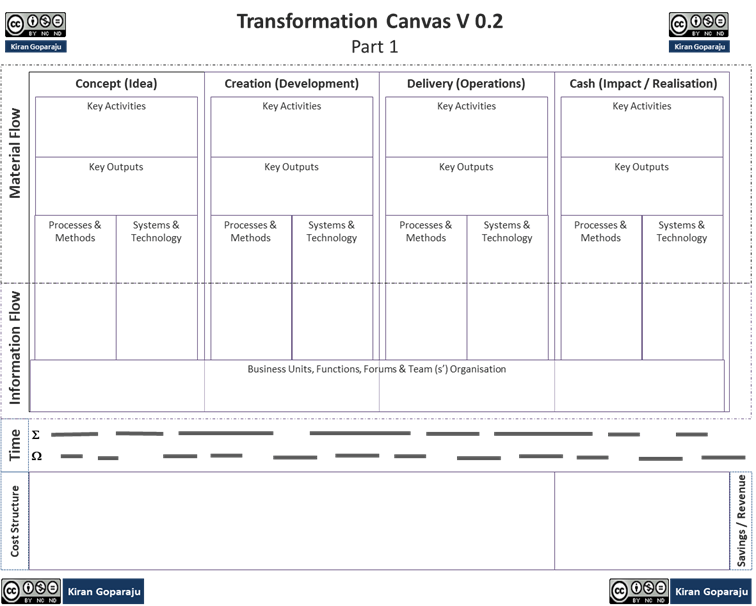
Part 1: Position of endeavour in the value network:At the heart of this Canvas is a value network analysis identifying network agents from concept to the cash (or idea to impact if you prefer) aligned to your strategic objectives & key results. In the context of Enterprise Transformation, Strategy (or strategic direction of travel) is considered given. This canvas doesn’t deal with possible future business models or strategies to adopt, but given a direction, how to enable or transform the organisation in realising that ambition is the focus.
Part 2: Map the value flow: In this part, we map all the stages across “value ideation, value creation, value delivery and value realisation”, currently in place to achieve the stated strategy / ambition. This typically involves multiple business functions / departments / business units. Material & Information flow through this value stream over time. We need to identify a) Key activities, b) Key outputs c) Process and methods used d) systems & technology involved e) organisation of teams involved across these four stages. Any such value creation for the customer involves some costs and also some expected payback. The purpose of this is to identify transformation opportunities across people, process & technology that no longer serve the purpose. The data collected could be populated like this:
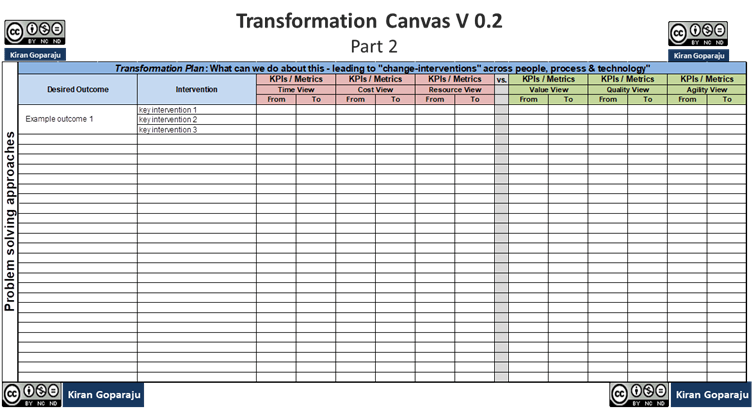
Part 3: Identify the interventions: The real power of this Canvas is what you do with the data gathered from above two parts. This analysis & synthesis highlights a laundry of this “we could do” in order realise “outcomes if we were to transform”. This is the third part of the Canvas (under the head “change interventions and key measures”). Depending upon the industry and the needs of the organisation, the key measures can take “time, cost, resource, quality, value or agility” dimensions. In fact, there could be many interventions across all such dimensions. The most important item here is what problem solving approaches the team has in spotting and addressing improvement areas then a list of interventions we ‘d like to implement. This could look like this:
PrincIples
This framework relies upon the following principles:
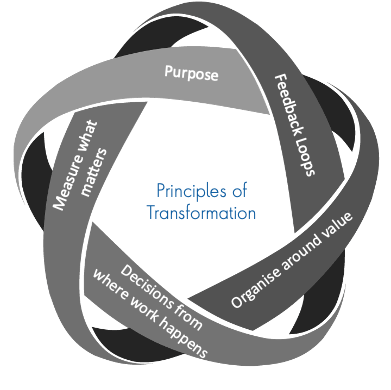
- Establish & articulate the “purpose”: Here “purpose” is used in a broad-sense. It may sound like a cliché or dead-obvious, but figure out the purpose and articulate the same for the endeavour at hand. This can be at an entire organisation level or down to a product / business unit or a project level. Articulation of this for a shared understanding / shared mental model is critical. There is no need for “alignment” to a large extent, as long as the mental model is shared, teams can have divergent collective or individual objectives. This purpose drives how teams shall organise around value (#2)
- Organise around value: It is more than a cliche, definitely not like the one used in SAFe, where the value doesn’t align with the framework. Organising around value includes / stipulates that “the team responsible for creating & delivering value has the direct line of sight” to the end users / customers. / value recipients. It’s neither about functional silos nor about cross-functional teams or contractual obligations; not even about waterfall methods or agile methods. You need to raise above all these and organise the team(s) around the value that is intended from the endeavour at hand. It is possible that there would be a large number of functions with their own ways of working. This team calls the shots on resource allocation and decision making.
- Bring decision making to where work happens (i.e. where value is created and captured): #2 implies this. This is about empowerment, not delegation. Those closest to the value creation & capture are better placed to make decisions. It does have some unintended consequences but the benefits outweigh the risk. When you organise around value and have data supporting operations, it makes it easier to cede control (from decision making forums to delivery / operational teams). This requires a lot of psychological safety for the team to make decisions.
- Establish frequent feedback loops: I’m not invoking agile methods’ demos / Show & Tell here. It is deeper than that. Feedback loops come in different form & shapes. These loops should work across the system, i.e. need to focus more on interactions amongst system components. Each process, system and team may be fulfilling their part well in isolation, it is their interactions that needs careful attention. Decision making on shop floor could have unintended consequences like suboptimal decisions or breaking something as the team doesn’t have expertise in a remote field they are interacting with. These feedback loops shall act as safety net reducing the blast radius. Make no mistake – there will be some blasts. Failure is an option, just need to be prepared for this
- Clear and measurable KPIs: These come from the purpose. These are not milestones, but answers “how do we know if we are successful?”
Practices
Mapping (using part 1 of the tool) is only the beginning. What you do with this information in order to transform is the fundamental question. This is where practices help. Many of these are not new, but for some I changed the construct. Not all these practices needed to be implemented, but they serve as a starting point. Though these are not discrete, i.e. there us a lot of overlap, I grouped them under the principles for ease of understanding. Here is an outline of practices, each one requires in-depth explanation to make it practical, which is NOT provided here.
Detailed explanation of these practices will come out soon
Principle 1: Establish & articulate the “purpose”
Practice 1: Weak Signal Detection: This practice is about developing an Organisational Radar, to scan the horizon (inside ->out, outside->in, top down, bottom up), accessible to everyone across the hierarchy and also to the other network agents outside the legal edges of the organisation. This shall feed into systems, processes & ways of working. Though there are many such tools already available, I developed a Business Model Innovation Tracker (to be discussed separately) to serve this purpose.
Practice 2: Value Network Analysis and OIKRs (Objectives, Initiatives and Key Results). Well, this is not exactly one practice, but this is well-established in many organisations, but I do call for few fundamental changes (coming soon)
Practice 3: What, How & Why perspectives of value: Follows Practice 2. TUDelft’s approach is a good starting point. There are plenty of others like Design Thinking & Service Design. This is more than “project vs product” debate.
Principle 2: Organise around value
Practice 1: Emergent Operating Model / Scaffolding: Dave Snowden spoke about this extensively.
Practice 2: Focus on SoCs: Though there is a proliferations of hundreds of systems even in medium-sized business, these “Systems of Creation & Delivery” didn’t get as much attention or love as that of Systems of Record or Systems of Engagement. Integrate where possible, orchestrate interaction of components, not control / manage components themselves. Automation & DevOps toolchain are good starting points.
Practice 3: Economic Chain / Value Network Accounting: These are gaining traction even in SEC filings now a days. Traditional methods are inadequate to account for value.
Principle 3: Bring decision making to shop floor
Practice 1: Executive Action Teams – I, unashamedly, picked this from Scrum @ Scale, but needs amending a lot. This shall be transient not static, to start with. Over time, role of middle & senior manager changes leading to network organisations. By the way, Matrix organisations, Spotify models (though there isn’t one) highlighted the need. Implementation requires skill & careful attention. Fluid Operating Model or Scaffolding comes into play
Principle 4: Establish frequent feedback loops:
One practice could be a meta-construct of above models, especially “executive actions teams” at the higher echelons of the organisations together with data coming from integrated SoCs.
Principle 5: Clear & measurable KPIs
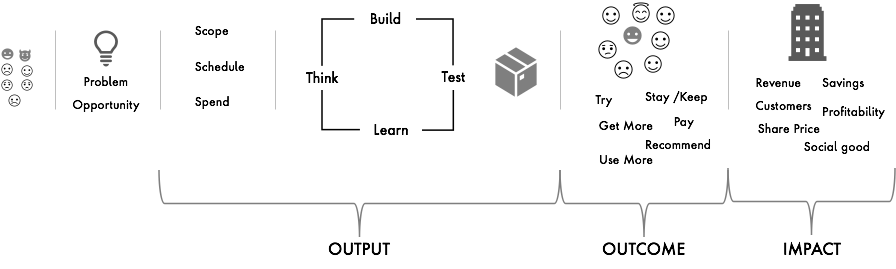
There are plenty of practices that help in identifying & measuring KPIs, which can broadly categorised into “outputs, outcome and impact”. Pick the one the suits the task / endeavour at hand. As a rule of thumb – “impact is better than outcome is better than output”.
Please note that the framework is NOT expected to be static. Canvas, together with practices, provides varying perspectives depending upon the point of view of endeavour at hand. Canvas (which in itself appears as 4 silos and multiple hierarchies) morphs into clusters & nodes or as a network as you traverse through the transformational efforts as below (well, I’m not saying “genie” would come out, but you get the idea)
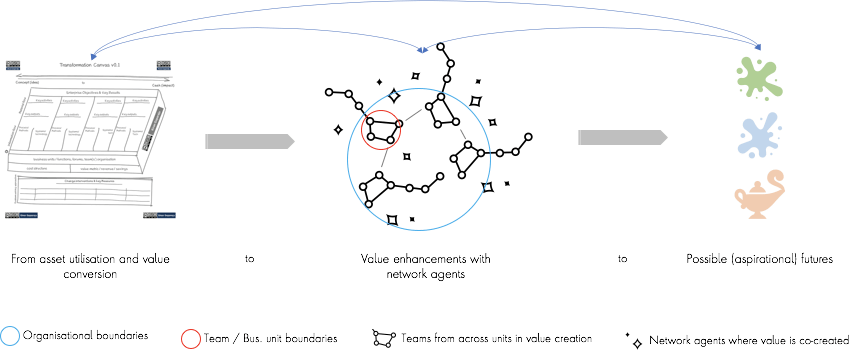
Hope you find this Transformation Canvas useful. Contact me if you want to share your thoughts or if you have any feedback.
Additional Info – Foundations
Apart from my experience in large organisations, where I tested this framework in parts, I used the following in developing Transformation Canvas, though not just limited to these:
Concepts
- Anthropology
- Complexity Theory
- Evolutionary Biology
- Epistemology
- Lean & Agile Thinking
- Operations Research
- Organisational Design
- Sociology
- Systems Thinking
- Theory of Constraints
Management & Delivery Frameworks
- Value Streams (Chains, Networks, Constellations)
- Business Models (both Harvard & MIT camps)
- Agile (XP, Scrum, SAFe, LeSS, DA…)
- Lean Operations
- Sequential / Traditional / Waterfall (Prince 2, PMP)
- Work & Motion studies / Scientific Management
- Creativity, Innovation & Problem Solving Approaches (Design Thinking, Service Design, SCAMPER, TRIZ, Morphological Analysis etc.)
Books / Corporate Research
- Management Challenges for the 21st Century by Peter Drucker
- Value Stream Mapping by Karen Martin and Mike Osterling
- Value Streams, Value Chains, Value Networks & Value Constellations (Michael Porter, Verna Allee, Richard Normann, Rafael Ramirez
- Business Models (Rita McGrath, Alex Osterwalder, Paolo Aversa, Stefan Haefliger, Danielle Reza, Adam J. Bock, Mark Johnson etc.)
- Complexity Theory & Sense Making (Dave Snowden)
- Measure What Matters by John Doerr
- The art of action by Stephen Bungay
- The Goal: A Process of Ongoing Improvement and Beyond the Goal: Theory of Constraints by Eliyahu M. Goldratt
- Lean Software Development: An Agile Toolkit by Mary Poppendieck, Tom Poppendieck
- Various articles from HBR.org. Sloan Management Review, McKinsey, BCG etc.)
 Enterprise Transformation